|
Thinking with visual language |
|
Professional development through art-based thought process |

|
Ideas & building‑block shapes |
|
Organize colour for communication richness |
|
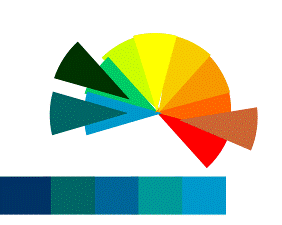
Colour has a dual nature that touches on both science and the senses. Our experiences with the visible part of the light system, the colour spectrum, are largely emotional. Yet colour has a coherent theory platform that is useful in identifying its hues and organizing its combinations. |
|
Identify colour properties to understand their organization.
Manage multiple dimensions.
Gain awareness of perceptions.
Communicate more richly with the help of colour theory.
|
|
WORKSHOP OBJECTIVES |
|
How can I
without changing the colour? |
|
Ideas that you will work with and discuss · Make progress when there is no right answer. · Unify subjective and objective concerns. · Differentiate the goals for stages of a creative project. · Focus externally to enrich outlook. · Separate experience and habit from knowledge and understanding. · Rediscover that after analysis, principles will enable us to put something back together. · Balance in colour is managing its dimensions. · Aim not to eliminate ambiguity but to explore the new possibilities it offers. · What impact does colour have on its environment? · What are some relationships that colour can affect? · Appreciate what you cannot measure or define. |
|
transformative
|
|
Change a colour |
|
Convert colour weight into
|
|
Conversion |
|
Cultural exchange |
|
Articulate what you see and feel
|
|
The visible spectrum is perceived through science and sensation
|
|
imagery |

|
Workshops in visual thinking |


|
Visual Language for elementary teachers |